




Electronic waste can cause negative impacts to the environment when it is not managed properly and well. Electronic waste or hazardous and toxic waste (B3) that enters the environment will result in soil acidification which can damage it, so the land cannot be used for farming or residential. This waste can also contaminate ground water and air with harmful substances.
If the waste has polluted the environment, the chemical substances will have dangerous impacts on human health. It causes cancer (carcinogenic effects), heart damage, liver and spleen damage, chronic brain damage, bronchitis, and even the potential to damage DNA (mutagenic and teratogenic effects).
Other than indirectly impacting human health, it has direct impacts on human because it has the potential to harm human with explosions, fires and corrosive reactions.
Limited awareness about e-waste management often leads to e-waste being discarded together with other types of trash. In fact, improper e-waste results in negative impacts to the environment.
The Jakarta Provincial Government has made waste banks one of the solutions for processing inorganic waste such as paper, glass, plastic, and cans. It is different with electronic waste. Department of Environmental Services has an electronic waste collection program, and there is even an electronic waste pickup to help that. This is considered important in reducing the harmful impacts of electronic waste. In addition, electronic waste is collected so that it can be managed so that it can be useful and valuable.
The legal framework regulating e-waste management is stipulated in Law Number 32 of 2009 on Environmental Protection and Management, Law Number 18 of 2008 on Waste Management, Presidential Decree Number 61/1993 on the Ratification of the Basel Convention, Presidential Regulation Number 47/2005 on the Ratification of the Ban Amendment, and Government Regulation No. 101/2014 on Hazardous and Toxic Waste Management.
The e-waste collection movement is centralized at the Department of Environmental Services. Before being transported to the department's office, e-waste is also collected at sub-district and urban village offices, public and private schools, mayor offices and other local government agency offices, as well as during Car-Free Day events at the HI Roundabout.
The Department of Environmental Services of Jakarta also provides e-waste drop boxes available in several locations such as Jakarta City Hall, several TransJakarta bus stops, and commuter train stations. This aims to facilitate Jakarta residents to properly dispose e-waste.
E-waste collected at the Warehouse of the Department of Environmental Services of Jakarta is transported periodically, once every 2–3 months, by a partner specializing in Hazardous and Toxic Waste (B3) utilization services. Legally, the Provincial Government of Jakarta (through the Department of Environmental Services of Jakarta) has partnered with PT CAR for E-Waste Management, formalized through a Cooperation Agreement (PKS).
Further processing conducted at PT CAR is illustrated in the following flowchart:

The stages of e-waste processing at PT CAR are as follows:
An ingot is the result of smelting, a basic liquid metal that is then poured and molded into simple shapes, requiring further processing. Ingot serves as a source of metal raw materials without the need for natural mining.
The Department of Environmental Services of Jakarta provides e-waste dropboxes for electronic waste collection at government offices, TransJakarta bus stops, schools, and commuter train (KRL) stations. The type of e-waste which can be put into the e-waste dropbox is small e-waste as the dropbox's input slot dimensions is only 20 cm x 5 cm, such as mobile phones, power banks, charging cables, iPods/iPads/tablets, and similar devices.
Residents can directly dispose of their e-waste in the dropboxes. At TransJakarta bus stops, the dropboxes are located inside the station, after the card gate area. The following is the example of documentation of e-waste collection activity conducted by a staff of the Department of Environmental Services of Jakarta at a TransJakarta bus stop.

The detailed list of e-waste dropbox locations in Jakarta is as follows:
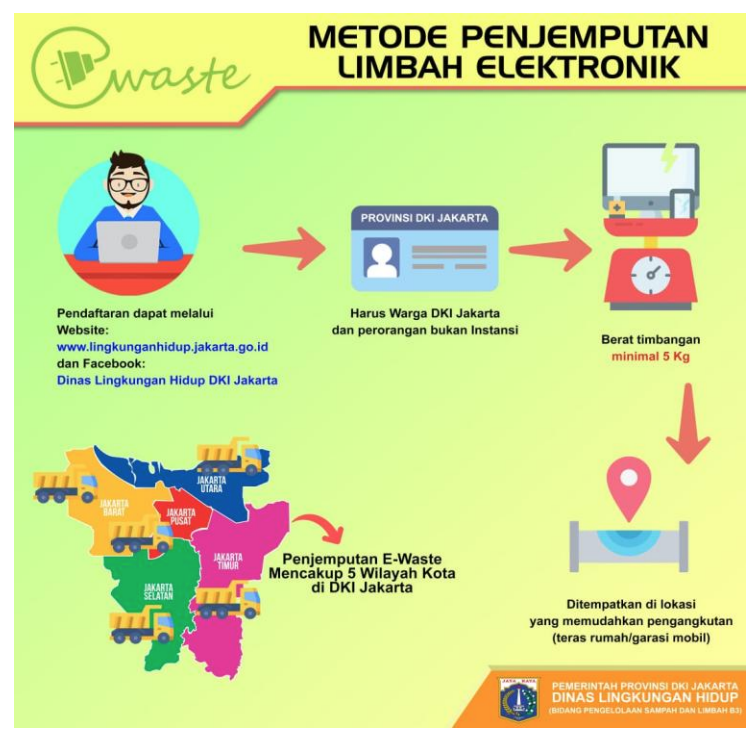
The steps for the e-waste pickup request process are as follows:

Harun, became one of the craftsmen in Harapan Isla...

The public attention toward air quality in Jakarta...

1. Pelaksanaan kegiatan Pekan Gerakan Jakarta Sada...
Department of Environmental Services


 id